How to Find the Right Taxation Lawyer in India for Business
- The Legal Strategy Review
- Jul 1
- 5 min read
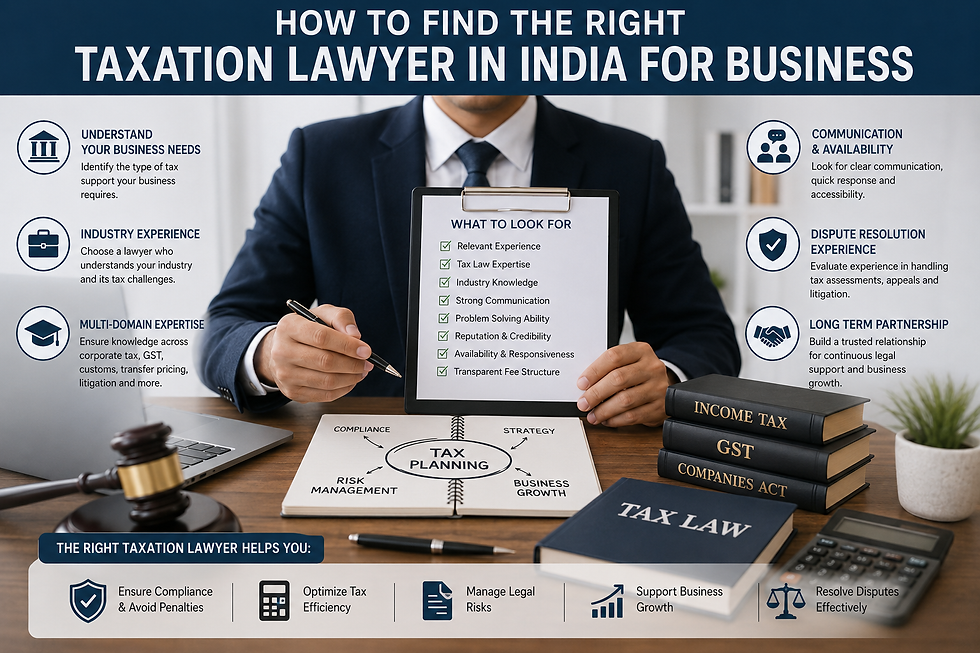
Every business, regardless of its size or industry, faces tax related obligations throughout its journey. From business formation and daily compliance to mergers, acquisitions, restructuring, and dispute resolution, taxation plays a central role in commercial success. As tax laws continue to evolve, businesses require legal guidance to manage risks, maintain compliance, and make informed financial decisions.
Choosing the right legal professional is more than finding someone with knowledge of tax statutes. Businesses need a lawyer who understands commercial objectives, identifies potential legal risks, and provides practical advice before issues become costly disputes.
This article explains how businesses can identify the right taxation lawyer in India and what factors deserve careful consideration before making a decision.
Why Businesses Need a Taxation Lawyer
Tax laws in India have become increasingly comprehensive. Businesses must comply with various regulations covering direct taxes, indirect taxes, international taxation, transfer pricing, customs, and other financial obligations.
A taxation lawyer helps businesses by:
Advising on tax efficient business structures
Assisting with regulatory compliance
Reviewing commercial transactions from a tax perspective
Representing businesses before tax authorities
Managing tax investigations and litigation
Supporting cross border investments and international taxation matters
Identifying legal risks before transactions are completed
Professional legal guidance often prevents disputes instead of merely resolving them after they arise.
Understand Your Business Requirements
Every business has different tax related concerns. Before selecting a lawyer, it is important to identify the type of assistance required.
A startup may need advice on business structure and initial registrations. A growing company may require support with GST compliance, tax planning, or expansion. Large corporations often deal with complex transactions involving mergers, acquisitions, transfer pricing, or international tax regulations.
Clearly defining business needs helps narrow the search to lawyers with relevant experience.
Look for Relevant Industry Experience
Tax laws apply differently across industries. Manufacturing businesses face different tax considerations compared with technology companies, pharmaceutical businesses, infrastructure developers, or financial institutions.
A lawyer who regularly advises businesses within a particular sector is more likely to understand industry specific regulations, compliance challenges, and commercial practices.
Practical industry knowledge often leads to more efficient legal solutions.
Evaluate Knowledge Across Multiple Tax Areas
Business taxation extends far beyond filing returns or calculating liabilities.
An experienced taxation lawyer should possess knowledge across various areas including:
Corporate taxation
Goods and Services Tax
Customs and import duties
International taxation
Transfer pricing
Withholding tax
Tax litigation
Regulatory compliance
Business restructuring
A broader understanding allows the lawyer to identify legal implications before business decisions are implemented.
Assess Commercial Understanding
Tax advice should align with commercial objectives rather than focus only on legal provisions.
Businesses benefit from lawyers who understand commercial transactions, investment structures, financing arrangements, shareholder relationships, and long term growth strategies.
Practical legal advice helps businesses balance compliance with commercial efficiency.
Review Experience in Tax Disputes
Even businesses with strong compliance systems may encounter disputes with tax authorities.
A capable taxation lawyer should have experience representing clients during:
Tax assessments
Departmental investigations
Appeals
Tribunal proceedings
High Court litigation
Supreme Court litigation
Previous dispute resolution experience demonstrates an ability to manage complex legal challenges when required.
Check Regulatory Knowledge
India's tax framework changes regularly through legislative amendments, judicial decisions, policy updates, and regulatory notifications.
Businesses should choose lawyers who remain informed about evolving tax laws and understand how these developments affect commercial operations.
Continuous legal research reflects professional competence and improves the quality of legal advice.
Consider Communication Skills
Tax law can involve technical language which may be difficult for business owners without legal or accounting backgrounds.
A good taxation lawyer explains legal issues clearly, outlines available options, and communicates potential risks in simple language.
Effective communication allows management teams to make confident business decisions without unnecessary confusion.
Evaluate Problem Solving Ability
Strong legal advice extends beyond identifying legal provisions.
Businesses should look for lawyers who analyse practical challenges, anticipate future risks, and recommend workable solutions suitable for commercial operations.
A solution focused approach becomes particularly valuable during business expansion, restructuring, regulatory investigations, and dispute resolution.
Examine Professional Reputation
Reputation remains an important indicator of professional credibility.
Businesses may evaluate a lawyer through:
Professional experience
Significant matters handled
Published legal articles
Industry recognition
Client testimonials
Speaking engagements
Professional memberships
A well established reputation generally reflects consistent legal practice and trusted professional relationships.
Consider Availability and Responsiveness
Business decisions often involve strict deadlines.
Delays in obtaining legal advice can affect regulatory compliance, commercial negotiations, or ongoing transactions.
Before engaging a lawyer, businesses should understand response times, communication methods, and availability for urgent matters.
Reliable communication builds stronger long term professional relationships.
Understand Fee Structure
Legal costs should always be discussed before engagement.
Some taxation lawyers charge hourly fees, while others offer fixed fees for specific assignments or retainers for continuing legal support.
Businesses should understand:
Scope of work
Billing structure
Additional costs
Litigation expenses
Payment timelines
Clear financial expectations help avoid misunderstandings during the engagement.
Consider Full Service Legal Support
Tax issues often overlap with corporate, regulatory, employment, intellectual property, real estate, and commercial law.
Businesses handling major transactions may benefit from working with a corporate law firm in India capable of providing multidisciplinary legal support under one platform.
Integrated legal advice reduces coordination challenges and ensures different legal issues are addressed together.
Verify Experience in Business Transactions
Business growth frequently involves transactions with significant tax implications.
Examples include:
Business acquisitions
Asset purchases
Share transfers
Joint ventures
Foreign investment
Corporate restructuring
Business succession
An experienced lawyer identifies tax risks during negotiations and helps structure transactions efficiently while remaining compliant with applicable laws.
Importance of Preventive Tax Advice
Many businesses seek legal assistance only after receiving notices from tax authorities.
Preventive legal advice is often more valuable.
Regular legal reviews can identify compliance gaps before they develop into disputes. Early legal guidance also supports better documentation, stronger governance, and improved regulatory compliance.
Preventive planning usually reduces legal costs over time while protecting business interests.
Technology and Modern Legal Practice
Businesses increasingly expect lawyers to use technology for document management, communication, compliance tracking, and secure information sharing.
Modern legal practices often provide:
Digital document management
Virtual consultations
Secure data handling
Faster document review
Improved response times
Technology enhances efficiency without compromising professional standards.
Build a Long Term Professional Relationship
Selecting a taxation lawyer should not be viewed as a one time decision.
As businesses grow, legal requirements become more sophisticated. Long term legal advisors develop a deeper understanding of business operations, commercial priorities, and industry specific risks.
This familiarity allows them to provide more practical and commercially relevant advice over time.
Businesses seeking continuous legal guidance often benefit from engaging an experienced taxation lawyer in india who can support both routine compliance and complex strategic decisions throughout different stages of growth.
Final Thoughts
Finding the right taxation lawyer in India requires careful evaluation of experience, commercial understanding, legal knowledge, communication skills, and professional reputation. The objective is not simply to address current tax concerns but to build a legal relationship capable of supporting future business growth.
A well qualified taxation lawyer helps businesses remain compliant, manage legal risks, navigate regulatory changes, and approach commercial opportunities with greater confidence. By investing time in selecting the right legal advisor, businesses place themselves in a stronger position to achieve sustainable growth while maintaining sound legal and tax practices.


Comments